Mario Villalobos

An MLB.TV Subscription Is the Best $130 I Ever Spent

  • Notes

Alissa Wilkinson, the film critic and culture reporter for Vox, on why baseball gave her a different narrative to follow and why she needed it:

Coming back to watching it this season feels like reinserting myself into a glorious story. I needed a reminder of where I’ve come from, and who I am, and how far I’ve gone.

[…]

Watching baseball, right now, I’m reminded of two things. This part of my life is part of a bigger story I’ve been living for a long time. And as much as I love narrative media and great stories, life is a lot more like an open-ended game where the end isn’t written yet. That’s frightening, but it’s also invigorating. A win is just as likely as a loss, and nobody loses forever.

This story resonated with me because it mirrors what I’ve been going through the past few weeks. Since I’ve found myself with a bit more time than I’m used to, I’ve decided to start following my hometown baseball team again, the San Diego Padres.

When I was a kid, all I ever did was follow the Padres. I remember I would steal every copy of the San Diego Union Tribune just so I can nab the Sports section and cut out the box score and the story to whatever game the Padres played the day before. I remember how this was one of the first uses of a notebook for me, and I loved it. I remember Tony Gwynn and Ken Caminiti and Steve Finley and Greg Vaughn and Wally Joyner and Bruce Bochy and whoever else played for them when I was a kid. I remember the 1998 season and the heartbreaking World Series sweep by the Yankees. I remember tuning into every game I could while in high school, and I remember tuning out once I got to college. Thank goodness because the mid-2000 Padres were awful.

Over the past few weeks, I started to watch game highlights on the MLB YouTube channel and feeling that spark of interest return. I love seeing the Slam Diego Padres again, win or lose, and I even started to read Kevin Acee in the Tribune again. This all feels familiar, like I’m dipping back into a narrative of my life that never ended. I haven’t subscribed to MLB.tv like Alissa did, but goddammit, I’ve felt like it over the past week. I, too, am feeling a bit apathetic to TV and movies, and maybe what I need is sports. Hell, I even tuned into the Indy 500 for a bit yesterday because I needed something that wasn’t TV or movies, a story to follow1 that I wanted to see through.

Part of the reason why I had stopped following sports, though, was the painful heartbreak of being a sports fan from San Diego. The Padres haven’t been to the World Series since 1998, and don’t even get me started on the Chargers. But maybe I need that heartbreak again, the feelings of ups and downs that sports gives people. Who knows, maybe the Padres have a shot this year.

Molting

  • Journal

I’m continually amazed at my propensity to come up with excuses. These excuses aren’t great; in fact, they’re awful, but they’re enough to keep me from doing what I should be doing, things I know that will fulfill me once I start but—oh my god why are these things so hard to start? Why is it so hard to take that first step? And why do I let myself accept these lame excuses?

I’ve come up with lists and goals and plans and anything else under the sun to just get me moving in the right direction, but sometimes I feel like they’re just an illusion of forward motion instead of actual motion. And listen, I know we’re all only human and we can only do so much, but should that be enough? And is that only an excuse? Don’t be so hard on yourself, one might say, You’re doing more than others I know. I’ve heard it before. But if that were true, would I be where I am right now? Feeling this way? Am I doomed to always feel this way?

I think so, and I don’t think so. Things are somewhat slowly taking shape in my head, and I kinda sorta know what I’m doing, and I’m like this close to taking that first step, but part of what’s holding me back is 1) time, 2) money, and 3) my own fear and inertia. I’m watching Tiny World on Apple TV+, and there was this segment in an episode that showed a praying mantis shedding its skin and coming out bigger and stronger than it was before. The metaphor is obvious. I’m in that molting stage right now, and I’ll come out of this stronger. I know I will.

And if the images in my imagination come true, then holy shit will I enjoy life that much more soon. If not, then, I guess I’m doomed to live in mediocrity forever. Either way, I’m at least okay that I’m alive to write the story, and that’s pretty cool.

What Pornography Is to Sex, Social Media Platforms Are to Our Intrinsic Appetite for Socialising.

  • Notes

Mark Miller and Ben White in an essay about social media published on Aeon:

Depression, for instance, has been described as a form of ‘cognitive rigidity’, where the system fails to adjust how sensitive it is to corrective feedback from the world. For people in good mental health, emotional feedback allows them to flexibly tune their expectations: sometimes it makes sense to ‘write off’ a prediction error as just noise, rather than see it as something that demands a change in their generative model of the world; other times, it makes sense to change our model because of the error. In depression, researchers hypothesise that we lose this ability to move back and forth between more or less ‘sensitive’ states, which results in rising and unmanageable prediction error. Eventually, we come to predict the inefficacy and failure of our own actions – which in turn becomes a self-reinforcing prediction, which we achieve some minimal satisfaction from confirming. At the level of the person who is depressed, this manifests in feelings such as helplessness, isolation, lack of motivation and an inability to find pleasure in the world.

I’ve suffered from depression for most of my life, and I can of course recognize when those feelings of “helplessness, isolation, lack of motivation and an inability to find pleasure in the world” happen, and my best medicine to combat them has been both giving myself time to heal and surrounding my life with as much pleasure as I could find.

I started to use social media in high school when I first joined Friendster and MySpace, but those were just silly diversions and not really what we recognize as social media today. Around this time, I spent a lot of time in AOL chat rooms where I mostly wrote “a/s/l” and “15/m/ca” (or whatever) and wait to see who would chat with me. I remember I made about a dozen “friends” this way that I contacted on and off throughout my time in high school. I remember friends from South Dakota and Texas to this day, but I don’t remember their names anymore. It’s been ages since I’ve thought about this. Wow. But then I joined Facebook in 2004 when a freshman at USC, and I’ve been a part of a social media platform ever since, at the expense to my mental health.

For me, social media was an easy way to socialize. I didn’t have to see people, and I didn’t have to talk to have conversations with them. Ever since I was a kid, I’ve battled with my stutter, and to compensate, I learned to both speak fast and to mumble, to not give my stutter a chance to happen and make me feel bad about myself. But this, in turn, made me even more difficult to understand, and whenever somebody said, “Huh?” or “What’d you say?”, I felt bad and I would just shake my head and say, “Nothing,” or “Nah, not important.” And because of this, I had a very hard time making friends, something Facebook “fixed.”

So I grew used to socializing this way, chatting, making plans, etc. And because I went to film school, most of the things my friends and I did was, well, watch movies, one of the most anti-social activities ever invented. And I loved it. I wrote and expressed myself with my stories, and I wrote and expressed myself on Facebook. But because Facebook and social media was how I made friends, I spent a lot of time alone and seeking validation on these platforms.

Later in the essay, the two authors write that:

So-called ‘Snapchat surgery’ makes perfect sense within the predictive processing framework. If we become accustomed to our own doctored appearance, and to receiving all of the feedback associated with it, soon the level of validation available offline will be registered as mounting prediction error. That’s likely to result in feelings of stress, and inadequacy. Through the lens of predictive processing, we see that getting surgery to look more like a filtered image is just the system doing what it always does: it’s no different from grabbing a blanket as the temperature begins to drop. We’re sampling the world to bring us back into an expected state. But social media is capable of displacing our self-image so much that the only way to rectify the error and meet those expectations is to surgically alter the way we look.

Emphasis mine. Social media taught me that the only way to be liked is how many likes, hearts, comments, @-mentions, or whatever other metric in place each of my posts generated. Every time I posted something, I intentionally glued myself to whatever app it was I posted to and waited. I waited to see the reactions happen in real time, and whenever I didn’t get enough or when the one person I wanted to reply didn’t, I felt bad. I felt awful. I felt like hurting myself. This is so damn ridiculous that I can’t believe I’m writing these words right now. Why would I do that? Why would I care?

Well:

Of course, there’s a more obvious way to alleviate these problems: spend less time online. For some of us, this is easier said than done, as mounting evidence supports the suspicion that social media can be addictive. A comprehensive review in 2015 defined social media addiction as a disproportionate concern with and drive to use social media that impairs other areas of life, and found that roughly 10 per cent of users exhibit symptoms of addiction. Interestingly, this is around the same percentage of people who have problems with alcohol – but while the addictive hooks of alcohol are relatively well understood, those of social media are not. Predictive processing might once again hold the key to understanding exactly how the features of particular platforms come to have such an effect.

I was addicted. It makes sense. Social media has been a part of my life for over 20 years now, and the first step toward healing is admitting you have a problem. I have a problem. I know this. I’ve known this, but I feel like now, I’m trying, finally, to do something about it.

And I have two things I’m trying to do to improve this situation for myself. One is to identify the friends I have now and start trying to improve my relationship with them. Yesterday, a friend of mine confronted me and asked me why I haven’t been talking to her as much recently, and I finally confided in her with some of my thoughts of depression and suicide, and I think (hope?) our friendship can improve because of it. It was scary and I felt very vulnerable, but after I said the words out loud, I felt better. Is that selfish? I’m not sure. I hope it isn’t.

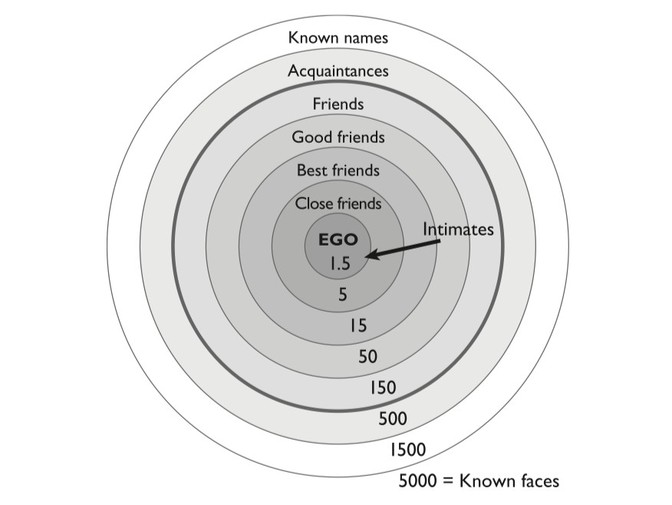
The second thing I want to do is increase my number of friends. I saw this photo in an article in The Atlantic the other day that I really resonated with. It shows a rough estimate of an average person’s average friend circles. Now let me tell you, I don’t think I have any intimates, close friends, best friends, or good friends, and I definitely don’t think I have 150 “friends.” This is one area I would really like to improve, but I don’t know how, not really.

Everyone says it’s tough to make friends as an adult. If that’s not a challenge worth accepting then I don’t know what is. So: challenge accepted.
School’s Out!

  • Notes

Actually, the last day of school was yesterday, but life has been literally everywhere the past few weeks that I finally found some time to write about it today. I’ll miss the students, especially the newly graduated seniors that I’ve seen grow up for the past seven years, and I’ll miss the little kids, many of whom I can’t wait to see grow up. The last week of school for the teachers is next week, so I still have some time left with them1. Then I have the entire summer to work on some projects, to reevaluate my life, and see where I want to be come fall. Thankfully, it doesn’t seem like the coronavirus will impact us much next year2, so it seems like things are starting to feel normal again.

In hindsight, this was probably one of the better years for me in terms of my job and my relationship with the staff and students. I had more highs than lows, and I can only hope for more good things next year. But now I’m looking forward to this three-day weekend, the shorter week next week, and the entire summer to enjoy. The 2020-2021 school year is officially in the books! Phew.


  1. Fortunately for some, unfortunately for others, but isn’t that how it goes in whatever job you have? ↩︎

  2. Knock on wood… ↩︎

Heather Cox Richardson Has a New Podcast?!

  • Notes

It’s called Now & Then, and here’s the synopsis from the show’s website:

How can the past help inform today’s most pressing challenges? Every Tuesday, award-winning historians Heather Cox Richardson and Joanne Freeman use their encyclopedic knowledge of US history to bring the past to life. Together, they make sense of the week in news by discussing the people, ideas, and events that got us here today.

I’ve been a big fan of Heather Cox Richardson’s newsletter, Letters from an American, a “newsletter about the history behind today’s politics,” for a few months now. It’s one of those daily reads that truly makes me feel smart, if not, smarter. Ben Brooks from The New York Times wrote a feature on her and her newsletter back in December, and what I didn’t know was that hers was the top newsletter on Substack.

Her new podcast with Joanne Freeman begins next Tuesday, June 1st, and I cannot wait.

What Now?

  • Journal

Well, this has been a strange week. It wasn’t quite the one I wanted, but it’s the one I got, so I shouldn’t complain. I wanted to write more, but instead I felt like I was in this liminal state, at the threshold between who I was and who I could be. I wrote about this feeling a few weeks ago, but I felt like this week was the culmination of weeks and months of thinking and feeling through these thoughts and emotions, and I’m now getting started on something.

What that something is I don’t know, but I know it doesn’t involve social media, so that’s a plus. When I decided to quit Micro.blog last week, I wanted to quit the endless and torturous cycle of publishing something then checking Micro.blog for comments, or when I had analytics, checking those stats for hits and referrals and more hits, then when that didn’t satisfy me, I would re-check Micro.blog and see if I got any new comments, and if I did, great, dopamine hit satisfied, but if I didn’t, I would step away annoyed and try to replace that feeling with something else. Later, when I wanted to publish something new, this cycle would repeat itself, and I would again enter this viciousness that I didn’t like or enjoy. I wanted to save my time and energy for more productive pursuits, to write more, to read more, to photograph more, to create more, and… a week isn’t long enough to know how this is going, but I think it’s going okay, all things considered.

If anything, this week was simply a big reset. Like I wrote about in that declaratory post, I’ve grown used to not using social media platforms like Facebook, Instagram, and Twitter, but that’s mostly because I replaced it with other social media platforms, like Micro.blog. So not having anything felt strange. I really didn’t know what to do with myself. I kept doing my normal things, like journaling in the morning, studying Japanese, and starting a new book, but once I did my work, I had all this time still left unspent that I wasn’t sure what to do with. I found myself picking up my phone every time I felt unsure what to do next, but since I didn’t really have anything to check on my phone, I put it down and felt unfulfilled. I’ve grown used to picking up my phone and seeing if I had new notifications or new things to read in whatever feed I had let infest my life, but now that I didn’t have anything like that, I really didn’t know what to do with myself. I kept asking myself, What now?

These feelings lasted for days. I felt stuck in this loop of old patterns that took all my energy to break free from, the same energy I wanted to devote toward my more creative pursuits, the same pursuits that was the whole purpose of my declaration in the first place. But breaking old habits is tough, and I can still feel and hear the background static that years of bad habits have produced. I don’t know how much longer it’ll last, but I feel like I’m finally walking down the right path for myself.

On Friday, I felt the urge to blog again, so I wrote a few posts over in my Stream. It wasn’t much, but it was enough to wake me up again. I picked up my notebook again and started writing notes for a new novel that I want to start, something I haven’t done in about a year, maybe longer. These notes weren’t much, but they were more than I’ve done in a long time, so I consider that a win. I’m actually very excited to start this new book, and I don’t care who knows it.

When I turned a year older earlier this month, I wrote down what I wanted to do during the next five years. A five year plan. One of those things was to simply write a book I can be proud of. I’ve written a few books already, but I haven’t really been proud of them, not enough to send them off to people or publishers. They’ve felt unfinished, rushed, not my best work. So, I hope to simply write something I’m proud of. Not something that would sell, not something for other people to read, but something that I’m proud of. So that’s what I want to focus on. That’s how I want to live my life. And I feel like I’m now, finally, on that path.

I realize a week is too soon to really know for sure, but all I can do now is to keep walking and see what happens. So let’s see what happens.

It’s an Erect Penis, and an Erect Penis Is an Erect Penis.

  • Notes

The New Yorker’s Rebecca Mead with probably the best quote ever:

It’s an erect penis, and an erect penis is an erect penis.

It’s in a story about The Cerne Giant in Dorset, England. The Cerne Giant, if you don’t know (I didn’t), is:

[S]o imposing that he is best viewed from the opposite crest of the valley, or from the air. He is a hundred and eighty feet tall, about as high as a twenty-story apartment building. Held aloft in his right hand is a large, knobby club; his left arm stretches across the slope. Drawn in an outline formed by trenches packed with chalk, he has primitive but expressive facial features, with a line for a mouth and circles for eyes. His raised eyebrows were perhaps intended to indicate ferocity, but they might equally be taken for a look of confusion. His torso is well defined, with lines for ribs and circles for nipples; a line across his waist has been understood to represent a belt. Most well defined of all is his penis, which is erect, and measures twenty-six feet in length. Were the giant not protectively fenced off, a visitor could comfortably lie down within the member and take in the idyllic vista beyond.

Who wouldn’t want to lie down within a 26-foot long penis and partake in the beautiful scenery?

Just Use Your Mouth!

  • Notes

Currently, Craig Mod is walking across Japan, filling in the Kumano Kodō he has yet to walk. And because Craig Mod is Craig Mod, he started another newsletter to write about it. It’s temporary, running only for about a month, from May 11 to June 6, and already I look forward to reading it every morning with my cup of coffee that I’ll miss it when it’s gone.

Today’s issue, the eleventh one and titled Old Infrastructure, has this hilarious encounter with a group of elementary school kids:

I had stopped to chug an iced coffee from a vending machine. A group of thirty or so elementary school kids were being herded onto a nearby bus. They all wore the same dorky yellow hats; hats that would have gotten you punched at my elementary school. WHAT ARE YOU DOING? They screamed at me. Walking! I yelled back. OH YEAH, WHERE’D YOU WALK FROM? And I told them. I told them where I had walked from and they just said, HOLY SHIT.

In issue three, We Got Iced Coffee, he had another encounter with kids that had me laughing:

The elementary school children ran away from me giggling. They hid behind their umbrellas. As I passed I said to the umbrellas, Mighty fine little town you got here (as I say to most kids I pass — “nice town!” is a nice thing probably not enough people say, certainly not to kids, and I mean it too — these little towns are pretty nice), and one of the boys yelled back, Just what the heck race are you anyway?

Kids are so honest and unashamedly so that I wish we didn’t lose this trait as we get older. I love talking to kids, too, so I can relate to Craig’s impulse to write about it.

Earlier in issue #11, Craig met an old man who told him to:

Use your body when you’re young, he barked, And your mouth when you’re old! Ha ha!

Old. Young. Just use your mouth!

The Door

  • Journal

The background static felt especially loud today. I dreamt last night of my inevitable failure. I dreamt that I grabbed my phone, logged onto Micro.blog, and checked to see if yesterday’s post garnered any reaction. I woke up feeling awful. I felt awful because I didn’t dream about the content of the reactions, but the quantity. This is what happens when I use social media, and it’s what I’m trying to eliminate from my life, this incessant need to grab my phone, to grab any device near me, and check for hearts and thumbs up and @-mentions. I know this background static will be dominating my life for a few weeks, and I know it’ll eventually fade away, but I have to wonder what it says about me that this is what I dream about.

I wrote yesterday that I wanted to focus on the things that make me happy. A year ago, I wrote that:

I wish I wasn’t so anxious all the time. I wish it was easier for me to get out of my own way and just live. But it’s not. I have built up these walls around me to make me feel safe and secure from the world, and I’m only now realizing how much better I’d be without them.

I remember that day so clearly. I remember the drive to the river, and I remember the fire pit with the used diaper in it, and I remember taking out my microphone and recording the sounds around me. I remember driving on the back roads and seeing everyone’s ranches full of cows and horses and hay bales. I remember I drove to my friend Ginger’s house, how I pulled up to her driveway unannounced, how she invited me inside and showed me around, and how her two kids were so excited to show me their things, their rooms, their photos. I remember going outside and marveling at the absolute quiet of the place. No cars driving on the street, no one playing their music too loud, no ambulances or police cars blaring their horns. I remember driving back home and wishing my life were different, that I lived in that part of Montana instead of the one I lived in.

And I’m sitting here now thinking, Why hasn’t more changed since then? Why haven’t I done more? At the start of the year, I wrote a post where I asked myself, Will I be able to try street photography again this year? I have to laugh at that because I haven’t gone anywhere this year. I haven’t gone to the river or the lake or the city or anywhere beyond the walls I’ve been living behind my whole life. And it’s because I’m afraid.

I’m afraid of opening that door and walking through it. I’m afraid of seeing what’s out there, of trying new things, of exploring the unexplored. And what I beat myself up so much about is that for six years, I was a wildland firefighter. I ran toward the flames instead of away from them. And for four of those years, I was an EMT firefighter. I roamed the mountains as a single resource firefighter, taking charge as a squad boss when needed and as a medical professional the other times. I wasn’t and am not afraid to face the open flames or the open wounds, but I’m afraid of opening this damn door I’ve constructed, and I don’t know what to do about it.

This is the part of my life I want to change, the part I want to improve, the part I want to devote all of my energies toward. Because I feel like I need to. I feel like every force in the world is weighing on me as I reach my hand out toward the door, fighting for every step, and never quite able to carry it all past the threshold. So I’ve grown use to not even trying anymore. Of feeling content staying still, of sitting on my couch in my air conditioned room, of living behind these walls forever. But that’s not living, and dammit, I want to live.

Dave Morrow on How Quitting Social Media Changed His Life

  • Notes

Dave Morrow, from a video he posted to his YouTube channel in 2018:

So my theory for quitting these [social networks] was that even though I didn’t notice it, I felt like all the input of being on those platforms, every few days or every week or whatever, I would always have a bunch of background static, where conversations going in my head and I wouldn’t know why, but it’d be like I was always thinking about something or worrying if I had to do something on any social media platform, like respond to somebody or stuff like that.

[…]

What would happen if I took all the energy that I spent on social media—posting, replying, looking at stuff, anything you do on social media—I took all that mental energy, all that physical energy, and I just devoted it straight toward what makes me feel really good? That is photography and traveling to new places on foot, out on the mountains, out on the wilderness. So I’ll take all that energy from social media, which only gives me, if at any happiness level, a very low amount of happiness comes from social media for me. But if I took all that energy I was devoting towards that and pushed it all towards something that makes me feel really good, makes me feel really accomplished when I’m done, how much more would I accomplish every single year? If I just took all that energy and diverted it only to the things I like?

This is something I’ve been thinking about for a long time, but something I’ve been thinking about more since linking to Cory Doctorow’s essay earlier today. I’ve found it easier and easier to live without Facebook and Instagram and Twitter, but if I’m being honest with myself, it’s been easier because I replaced it with Micro.blog. I don’t like that I replaced one compulsion with another, regardless of how much more integrity this platform has over, say, Facebook. I don’t like the background static, like Dave Morrow so beautifully put it, after every post I publish or every response I write. It keeps me from creating, and creating is the one thing that keeps me happy.

So what if, like Dave Morrow says, I focus all my energy toward the things that make me feel really good? Toward the things I like? What would my life like that look like? Well… let’s find out.

Here’s my declaration: I’m quitting all social media, including Micro.blog, starting today. Like Dave Morrow, I want to focus all my energies towards the things I like, and that means writing, reading, photography, traveling, and anything else that flexes my creativity muscle. And hey, if that turns me into an even bigger asshole, so what?

Page 22 of 91